

Thanksgiving is more than a holiday tradition it is a spiritual weapon that opens heaven over your life. When you approach God with a grateful heart, you position yourself to receive fresh grace, deeper peace, and greater breakthroughs. Many believers pray for what they want but forget to thank God for what He has already done, and this robs their prayer life of power.
This article brings you 120 powerful Thanksgiving prayer points with Scriptures to guide your personal devotion, family altar, or church gathering. Each prayer point is rooted in the Word of God, written in simple language, and arranged so you can pray them daily throughout the Thanksgiving season and beyond. Whether you need prayers for spiritual growth, short prayers on the go, or church-style declarations of victory, you will find them all here, along with the biblical understanding behind why gratitude matters so much to God.
What Does the Bible Say About Thanksgiving
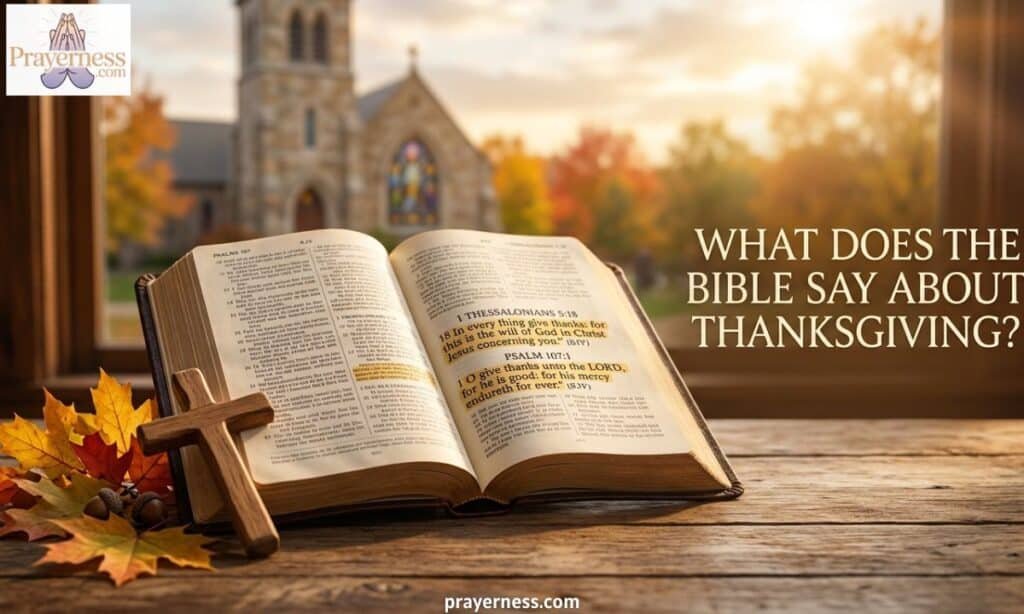
The Bible speaks about thanksgiving from Genesis to Revelation, and it is never presented as optional. Scripture consistently ties gratitude to obedience, faith, and worship. Paul instructs believers in 1 Thessalonians 5:18, “In every thing give thanks: for this is the will of God in Christ Jesus concerning you.” Notice that thanksgiving is called God’s will, not a suggestion for good days only.
The Psalms are filled with calls to thanksgiving. Psalm 100:4 says, “Enter into his gates with thanksgiving, and into his courts with praise: be thankful unto him, and bless his name.” This verse shows that thanksgiving is the doorway into God’s presence, not something we offer after we arrive. Psalm 107:1 adds, “O give thanks unto the LORD, for he is good: for his mercy endureth for ever,” reminding us that gratitude is a response to God’s character, not our circumstances.
Paul’s letters follow a consistent pattern worth noticing: nearly every epistle opens with thanksgiving for the recipients before moving into teaching or correction. In Philippians 1:3-4, he writes, “I thank my God upon every remembrance of you… making request with joy.” In 1 Corinthians 1:4, he thanks God for the grace given to a church he later has to correct sharply, showing that gratitude and honest correction are not opposites. This pattern teaches that thanksgiving can be extended even toward imperfect people and situations, focusing on God’s grace at work rather than only on visible flaws.
In the New Testament, Philippians 4:6 links thanksgiving directly to answered prayer: “Be careful for nothing; but in every thing by prayer and supplication with thanksgiving let your requests be made known unto God.” Colossians 3:15-17 also instructs believers to let the peace of God rule in their hearts and to “be ye thankful,” teaching, and admonishing one another with gratitude.
Here are a few key biblical truths about thanksgiving:
- Thanksgiving is commanded, not optional (1 Thessalonians 5:18)
- Thanksgiving is the entrance to God’s presence (Psalm 100:4)
- Thanksgiving should accompany every request (Philippians 4:6)
- Thanksgiving is rooted in God’s unchanging goodness (Psalm 107:1)
- Thanksgiving is a lifestyle, not a one-time event (Colossians 3:17)
Understanding what the Bible says about thanksgiving helps us pray with confidence, knowing we are aligning ourselves with God’s revealed will rather than simply following a religious custom.
The Old Testament also gives us a picture of organized, corporate thanksgiving. In 1 Chronicles 16:8-36, David appointed Levites specifically to give thanks before the ark of the covenant, showing that gratitude was structured into Israel’s worship life rather than left to chance. This chapter records David’s charge to “give thanks unto the LORD, call upon his name, make known his deeds among the people” (1 Chronicles 16:8), a pattern that connects private gratitude to public testimony.
Jesus Himself practiced thanksgiving before performing miracles. Before feeding the five thousand, He looked up to heaven and gave thanks (John 6:11). Before raising Lazarus from the dead, He prayed, “Father, I thank thee that thou hast heard me” (John 11:41). These moments teach that thanksgiving is not reserved for after a need is met; it can be spoken in faith while a believer is still waiting for the answer.
The Old Testament also introduced a specific category of worship called the thanksgiving offering. Leviticus 7:12-15 describes an offering brought purely out of gratitude, separate from offerings made for sin or vows. Psalm 116:17 reflects this practice: “I will offer to thee the sacrifice of thanksgiving, and will call upon the name of the LORD.” Calling it a sacrifice is significant; it suggests that giving thanks sometimes requires effort and discipline, especially when circumstances do not naturally inspire gratitude. This is why Hebrews 13:15 describes praise as “the fruit of our lips,” something believers actively offer, not merely something they feel.
The Spiritual Power of Thanksgiving in Prayer
Thanksgiving carries spiritual authority because it is an act of faith. When you thank God before your situation changes, you declare that you trust His character more than your current circumstances. This kind of prayer moves mountains because it is anchored in what God has already proven Himself to be, not just what you hope He will do.
Gratitude also guards the heart against bitterness, anxiety, and complaint. Philippians 4:6-7 promises that when thanksgiving accompanies our requests, “the peace of God, which passeth all understanding, shall keep your hearts and minds through Christ Jesus.” This peace is not a feeling that appears by accident; it is released through a deliberate posture of gratitude.
There is also a pattern in Scripture where thanksgiving precedes breakthrough. Jesus gave thanks before He multiplied the loaves and fishes (John 6:11). Paul and Silas sang praises in prison before the earthquake shook the doors open (Acts 16:25-26). In both cases, gratitude was expressed before the miracle, not after. This shows that thanksgiving is not merely a response to blessing; it can be a catalyst that invites blessing.
A few reasons thanksgiving carries spiritual weight in prayer:
- It activates faith by focusing your heart on God’s faithfulness rather than your fears
- It invites God’s presence, since Scripture says we enter His gates with thanksgiving
- It releases peace that guards the mind against worry
- It silences the enemy, because Psalm 8:2 says praise stills the avenger
- It prepares the way for miracles, following the biblical pattern of gratitude before breakthrough
When thanksgiving becomes the foundation of your prayer life, every other prayer you pray carries more weight because it flows from a heart that already trusts God.
This is why many prayer warriors describe thanksgiving as a weapon rather than just an emotion. Complaint and worry actually strengthen the grip of fear because they keep the mind fixated on the problem. Thanksgiving breaks that cycle by shifting attention to God’s proven track record. Psalm 34:1 captures this posture perfectly: “I will bless the LORD at all times: his praise shall continually be in my mouth.” Notice the phrase “at all times” David did not limit gratitude to seasons of ease.
There is also a corporate dimension to the spiritual power of thanksgiving. When believers gather to give thanks together, whether in a small group or a large congregation, their combined faith creates an atmosphere that Scripture associates with God’s manifest presence. Psalm 22:3 says God inhabits the praises of His people, suggesting that collective thanksgiving can usher in a tangible sense of His nearness that individual prayer alone may not always produce.
Common Themes Found in Thanksgiving Prayer
Across Scripture and across the prayer lives of believers today, a few recurring themes appear whenever thanksgiving is offered to God:
- Gratitude for God’s character — His goodness, love, mercy, and faithfulness, which never change regardless of circumstance
- Gratitude for past faithfulness — remembering specific ways God has come through before
- Gratitude for present provision — acknowledging daily needs that are met, such as food, health, and shelter
- Gratitude in advance — thanking God for what is trusted to come, even before it is visible
- Gratitude for relationships — family, friends, and community that reflect God’s care through people
Recognizing these themes can help you structure your own thanksgiving prayers so they feel complete rather than repetitive, covering both what God has already done and what you are trusting Him to do. Reviewing this list occasionally can also reveal which theme you tend to neglect, giving you a practical starting point for the next season of prayer.
Prayer Points on Thanksgiving With Scriptures
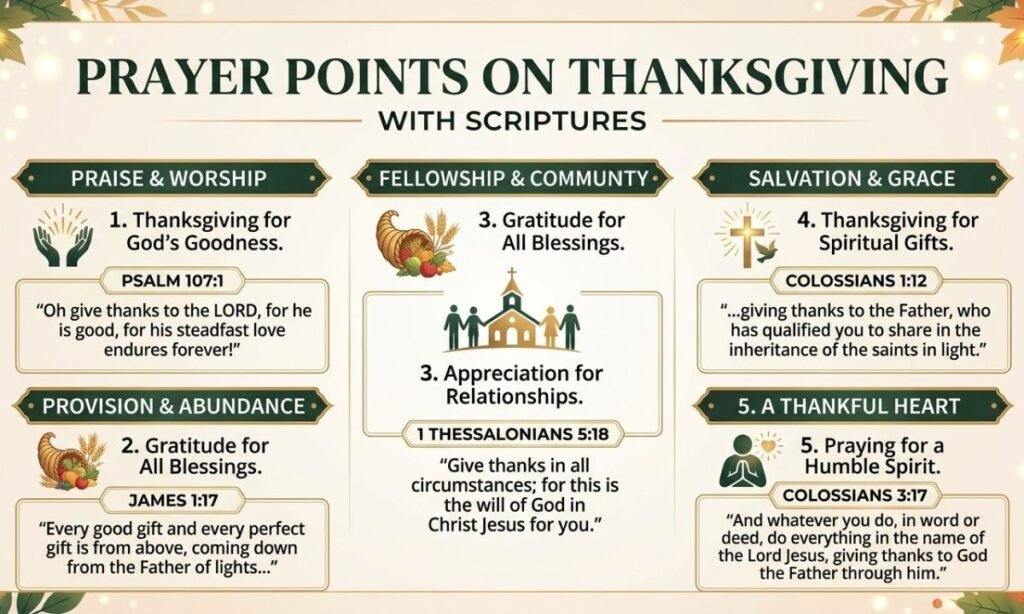
Use these prayer points as a starting place for a season of dedicated gratitude. Speak them slowly, personalize them, and let each Scripture strengthen your faith as you pray. They cover the everyday blessings that are easy to overlook, from health and provision to peace and purpose, so you can build a well-rounded habit of gratitude rather than thanking God for only the big, obvious things.
- Father, I thank You for the gift of life and another day to serve You. “This is the day which the LORD hath made; we will rejoice and be glad in it.” (Psalm 118:24)
- Lord, I thank You for Your mercy that is new every morning. (Lamentations 3:22-23)
- I thank You, Father, for the salvation of my soul through Jesus Christ. (Ephesians 2:8-9)
- Thank You, Lord, for Your unfailing love that never lets me go. (Psalm 136:1)
- Father, I thank You for answering my prayers in Your perfect timing. (1 John 5:14-15)
- Lord, I thank You for the food on my table and the roof over my head. (Matthew 6:11)
- I thank You, God, for the gift of good health and strength. (3 John 1:2)
- Father, I thank You for my family and every relationship You have given me. (Psalm 127:3)
- Lord, I thank You for peace in my heart despite the storms around me. (John 14:27)
- Thank You, Father, for opening doors that no man can shut. (Revelation 3:8)
- I thank You, Lord, for the gift of the Holy Spirit living in me. (Romans 8:11)
- Father, I thank You for Your Word that lights my path daily. (Psalm 119:105)
- Lord, I thank You for protecting me from dangers seen and unseen. (Psalm 91:11)
- I thank You, God, for the friends who encourage and stand by me. (Proverbs 17:17)
- Father, I thank You for financial provision and for meeting my needs. (Philippians 4:19)
- Lord, I thank You for wisdom that guides my daily decisions. (James 1:5)
- I thank You, Father, for turning my trials into testimonies. (Romans 8:28)
- Thank You, Lord, for the freedom to worship You openly. (2 Corinthians 3:17)
- Father, I thank You for Your faithfulness that has carried me this far. (Lamentations 3:23)
- Lord, I thank You for the hope of eternal life through Christ Jesus. (John 3:16)
Tips for Praying These Points Effectively
- Read the attached Scripture slowly before praying the point, letting the verse shape your words
- Personalize each prayer by inserting specific names, dates, or situations from your own life
- Pray them aloud whenever possible, since spoken gratitude reinforces faith
- Do not rush through the list; pause on any point that stirs a strong emotional or spiritual response
- Keep a small notebook nearby to jot down any fresh testimony that comes to mind as you pray
- Return to any point that feels especially relevant to your current season and repeat it over several days
Prayer Point for Spiritual Growth With Scriptures
Thanksgiving is not only about what God has given; it is also a tool for deepening your walk with Him. Many believers thank God for material blessings but rarely thank Him for inward transformation, yet Scripture places great value on spiritual growth. Peter urges believers to “grow in grace, and in the knowledge of our Lord and Saviour Jesus Christ” (2 Peter 3:18), showing that maturity is expected, not optional, in the Christian life. These prayer points focus on maturity in Christ, sensitivity to the Holy Spirit, and the character changes that come from walking closely with God.
- Father, thank You for growing me in grace and knowledge of Christ. (2 Peter 3:18)
- Lord, I thank You for the Holy Spirit teaching me all things. (John 14:26)
- Thank You, Father, for renewing my mind daily through Your Word. (Romans 12:2)
- I thank You, Lord, for the fruit of the Spirit developing in me. (Galatians 5:22-23)
- Father, thank You for strengthening my faith through every trial. (James 1:2-4)
- Lord, I thank You for teaching me to pray without ceasing. (1 Thessalonians 5:17)
- Thank You, Father, for helping me forgive as You have forgiven me. (Ephesians 4:32)
- I thank You, Lord, for drawing me closer to You each day. (James 4:8)
- Father, thank You for correcting me in love and not in anger. (Hebrews 12:6)
- Lord, I thank You for giving me hunger for Your presence. (Psalm 42:1)
- Thank You, Father, for helping me walk in humility before You. (Micah 6:8)
- I thank You, Lord, for planting me firmly in a Bible-believing community. (Hebrews 10:25)
- Father, thank You for maturing my faith beyond shallow emotions. (Ephesians 4:14-15)
- Lord, I thank You for teaching me to trust You in uncertainty. (Proverbs 3:5-6)
- Thank You, Father, for making me more like Christ every day. (Romans 8:29)
Signs That You Are Growing Spiritually
As you pray these points consistently, watch for these markers of genuine spiritual growth in your life:
- A growing hunger for God’s Word rather than a sense of obligation to read it
- Increasing patience and self-control in situations that once triggered quick reactions
- A deeper capacity to forgive others without holding on to resentment
- Greater peace in uncertain circumstances instead of constant anxiety
- A stronger desire to serve others and give generously, reflecting Christ’s own example
These signs do not appear overnight, but a consistent life of thanksgiving prayer, paired with Scripture reading and Christian community, steadily produces this kind of transformation over time. Rather than measuring growth by dramatic emotional experiences alone, believers are encouraged to look for these quieter, steady changes in daily attitude and behavior as the more reliable evidence of a heart being shaped by God.
Winners Chapel Thanksgiving Prayer Points With Scriptures
These prayer points reflect the Word of Faith style of thanksgiving prayer common in Winners Chapel and similar ministries, emphasizing praise, testimonies, and bold declarations of victory before results are fully seen. This style of prayer encourages believers to thank God as if the answer has already arrived, standing on the promises of Scripture rather than waiting for visible proof before expressing gratitude.
Declarations of Victory and Breakthrough
- Father, I thank You because my case is already settled in the courts of heaven. (Job 22:28)
- Lord, I give You thanks for turning my mourning into dancing. (Psalm 30:11)
- I thank You, Father, for every yoke You have broken off my life. (Isaiah 10:27)
- Thank You, Lord, for making me the head and not the tail. (Deuteronomy 28:13)
- Father, I thank You for prospering me in the works of my hands. (Deuteronomy 28:12)
- Lord, I thank You that no weapon fashioned against me shall prosper. (Isaiah 54:17)
- Thank You, Father, for silencing every voice of the enemy over my life. (Psalm 8:2)
- I thank You, Lord, for the testimonies that are already on their way. (Psalm 71:19)
- Father, thank You for divine health flowing through my body. (Exodus 15:26)
- Lord, I thank You for surrounding me with favor as a shield. (Psalm 5:12)
Declarations of Increase and Divine Favor
- Thank You, Father, for causing everything to work together for my good. (Romans 8:28)
- I thank You, Lord, for the fruitfulness You have decreed over my life. (John 15:16)
- Father, thank You for exceedingly and abundantly above all I ask or think. (Ephesians 3:20)
- Lord, I thank You for opening doors of increase that no man can shut. (Revelation 3:8)
- Thank You, Father, for my breakthrough that is already manifesting. (Habakkuk 2:3)
- I thank You, Lord, for lifting me above every limitation. (2 Corinthians 9:8)
- Father, thank You for restoring everything the enemy has stolen. (Joel 2:25)
- Lord, I thank You for establishing me as a lender and not a borrower. (Deuteronomy 28:12)
- Thank You, Father, for causing me to triumph in Christ always. (2 Corinthians 2:14)
- I thank You, Lord, for making my dreams and visions come to pass. (Habakkuk 2:2-3)
These declarations work best when spoken with conviction rather than doubt, since Scripture ties this style of praise to bold, faith-filled confession. Many churches that follow this pattern encourage members to write down the specific breakthrough they are believing for and pray the matching thanksgiving point over it daily until they see a testimony worth sharing publicly. Over time, this practice builds a personal record of answered prayers that can be revisited during future seasons of doubt, serving as tangible evidence of God’s faithfulness.
40 Powerful Thanksgiving Prayer Points With Scriptures
This extended list of 40 prayer points is ideal for a longer prayer session, a Thanksgiving Day service, or a week of daily devotion where you pray a few points each day. Consider spreading them across seven days, praying five or six points every morning, so that by the end of the week gratitude has touched every area of your life — your body, your relationships, your finances, your emotions, and your future. To make the list easier to pray through, it is grouped into four categories below.
Thanksgiving for Life, Health, and Strength
- Father, I thank You for waking me up this morning in sound health. (Psalm 3:5)
- Lord, I thank You for the breath of life You have given me. (Genesis 2:7)
- Thank You, Father, for the covering of Your grace over my household. (Psalm 91:1)
- I thank You, Lord, for the shed blood of Jesus that redeems me. (1 Peter 1:18-19)
- Father, thank You for hearing me every time I call upon You. (Jeremiah 33:3)
- Lord, I thank You for peace that guards my heart and mind. (Philippians 4:7)
- Thank You, Father, for the gift of Your Son, Jesus Christ. (John 3:16)
- I thank You, Lord, for strength that renews like the eagle’s. (Isaiah 40:31)
- Father, thank You for guiding my steps even when I cannot see the way. (Proverbs 16:9)
- Lord, I thank You for the gift of laughter and joy in my home. (Nehemiah 8:10)
Thanksgiving for Family, Community, and Provision
- Thank You, Father, for surrounding me with godly counsel. (Proverbs 11:14)
- I thank You, Lord, for the church family You have placed me in. (Acts 2:42) If your gathering also closes in prayer, you may find our closing prayer for Bible study collection helpful for ending your sessions on a note of gratitude.
- Father, thank You for the beauty of creation that reveals Your glory. (Psalm 19:1)
- Lord, I thank You for second chances and new beginnings. (Lamentations 3:22-23)
- Thank You, Father, for teaching me patience through waiting seasons. (Romans 8:25)
- I thank You, Lord, for confidence to approach Your throne boldly. (Hebrews 4:16)
- Father, thank You for keeping my mind stayed on You in perfect peace. (Isaiah 26:3)
- Lord, I thank You for every open door of opportunity this year. (1 Corinthians 16:9)
- Thank You, Father, for satisfying my mouth with good things. (Psalm 103:5)
- I thank You, Lord, for the gift of children and their laughter. (Psalm 127:3-5)
Thanksgiving for Restoration and Emotional Healing
- Father, thank You for restoring my joy after seasons of sorrow. (Psalm 30:5)
- Lord, I thank You for shielding me from the plans of the enemy. (Psalm 27:5)
- Thank You, Father, for the gift of a sound mind. (2 Timothy 1:7)
- I thank You, Lord, for teaching my hands to do good work. (Ecclesiastes 9:10)
- Father, thank You for keeping my marriage and home covered in love. (1 Corinthians 13:4-7)
- Lord, I thank You for divine connections and destiny helpers. (Ecclesiastes 4:9-10)
- Thank You, Father, for hearing the cry of my heart in silence. (Psalm 34:17)
- I thank You, Lord, for turning ashes into beauty in my life. (Isaiah 61:3)
- Father, thank You for the courage to face each new challenge. (Joshua 1:9)
- Lord, I thank You for Your promises that never fail. (Numbers 23:19)
Thanksgiving for Purpose, Peace, and the Future
- Thank You, Father, for lifting burdens I could not carry alone. (Matthew 11:28)
- I thank You, Lord, for restoring relationships that seemed broken. (Joel 2:25)
- Father, thank You for the assurance of Your presence everywhere I go. (Joshua 1:9)
- Lord, I thank You for teaching me contentment in every situation. (Philippians 4:11-12)
- Thank You, Father, for the gift of rest and sound sleep. (Psalm 4:8)
- I thank You, Lord, for every prayer You have already answered. (Psalm 116:1-2)
- Father, thank You for shielding my heart from fear and doubt. (2 Timothy 1:7)
- Lord, I thank You for the harvest that is coming after my season of sowing. (Galatians 6:9)
- Thank You, Father, for making all things beautiful in Your time. (Ecclesiastes 3:11)
- I thank You, Lord, for the assurance that You will never leave nor forsake me. (Hebrews 13:5)
25 Short Prayer Points of Thanksgiving With Scriptures
Sometimes you only need a brief, powerful line to express gratitude, especially during a busy day or a short devotional moment. These short prayer points are easy to memorize and pray anywhere — while driving, before a meal, or during a quick break at work. Their brevity does not reduce their power; a sincere short prayer carries the same weight before God as a lengthy one.
- Thank You, Lord, for today. (Psalm 118:24)
- Thank You, Father, for Your love. (Psalm 136:1)
- Thank You, Jesus, for the cross. (Romans 5:8)
- Thank You, Lord, for my family. (Psalm 127:3)
- Thank You, Father, for peace. (John 14:27)
- Thank You, Lord, for provision. (Philippians 4:19)
- Thank You, Father, for healing. (Exodus 15:26)
- Thank You, Lord, for my job. (Deuteronomy 8:18)
- Thank You, Father, for wisdom. (James 1:5)
- Thank You, Lord, for grace. (2 Corinthians 12:9)
- Thank You, Father, for mercy. (Lamentations 3:22-23)
- Thank You, Lord, for salvation. (Ephesians 2:8)
- Thank You, Father, for strength. (Isaiah 40:31)
- Thank You, Lord, for guidance. (Psalm 32:8)
- Thank You, Father, for protection. (Psalm 91:11)
- Thank You, Lord, for friends. (Proverbs 17:17)
- Thank You, Father, for Your promises. (Numbers 23:19)
- Thank You, Lord, for restoration. (Joel 2:25)
- Thank You, Father, for hope. (Romans 15:13)
- Thank You, Lord, for joy. (Nehemiah 8:10)
- Thank You, Father, for another chance. (Lamentations 3:23)
- Thank You, Lord, for Your Word. (Psalm 119:105)
- Thank You, Father, for answered prayers. (1 John 5:14-15)
- Thank You, Lord, for open doors. (Revelation 3:8)
- Thank You, Father, for tomorrow. (Jeremiah 29:11)
Consider writing three or four of these short prayer points on sticky notes and placing them where you will see them throughout the day — on your desk, your mirror, or the dashboard of your car. Small, repeated reminders like these help gratitude become automatic rather than something you have to consciously remember. For a similar practice in the evening, you can also explore our Sunday good evening blessings to close each week with thankfulness.
The Power of Gratitude in Hard Times
Thanksgiving is easy when life is going well, but its true power is revealed in difficult seasons. Job worshipped God even after losing everything, declaring, “The LORD gave, and the LORD hath taken away; blessed be the name of the LORD” (Job 1:21). Paul and Silas sang praises in a prison cell before their chains fell off (Acts 16:25-26). These examples show that gratitude in hardship is not denial of pain; it is a declaration of trust in God’s character despite the pain.
Choosing gratitude during trials shifts your focus from your problem to your Provider. It does not mean pretending everything is fine, but it means acknowledging that God remains good even when circumstances are not. Habakkuk 3:17-18 captures this beautifully: even when the fig tree does not blossom and the fields yield no food, the prophet still chooses to rejoice in the Lord.
Practical ways to practice gratitude in hard times include:
- Naming specific blessings instead of general complaints, even small ones like breath or shelter
- Reading Scripture that reminds you of God’s past faithfulness
- Journaling what God has already done, so you can look back during doubt
- Speaking thanksgiving out loud, since vocal praise strengthens faith
- Worshipping through music, following the example of Paul and Silas
When gratitude becomes your response to hardship rather than your reaction to comfort, your faith grows stronger and more resilient with every trial you face.
Modern research on gratitude echoes what Scripture has taught for centuries. Studies in psychology consistently link a regular gratitude practice to lower stress levels, improved sleep, and greater emotional resilience. While science cannot replace the spiritual dimension of thanksgiving, it does confirm that a thankful mindset changes how the brain processes difficulty, making believers more equipped to endure hardship without losing hope.
It is also worth noting what genuine gratitude in hard times is not. It is not pretending pain does not exist, forcing false positivity, or suppressing honest emotion before God. The Psalms are full of raw lament alongside praise, showing that believers can be honest about pain while still choosing to thank God for who He is. Psalm 42:11 models this balance: “Why art thou cast down, O my soul?… hope thou in God: for I shall yet praise him.”
Other biblical figures faced severe hardship and still found reasons for gratitude. Joseph, sold into slavery by his own brothers and later imprisoned unjustly, eventually declared that God had turned the evil intended against him into good for the saving of many lives (Genesis 50:20). Daniel continued his practice of thanking God three times a day even after a decree was passed making prayer illegal, choosing faithfulness over fear (Daniel 6:10). These accounts remind believers that thanksgiving in hardship is a decision made in advance, not a feeling that waits for favorable conditions.
Quick Scriptures to Memorize for Hard Seasons
- “In every thing give thanks: for this is the will of God in Christ Jesus concerning you.” 1 Thessalonians 5:18
- “Weeping may endure for a night, but joy cometh in the morning.” Psalm 30:5
- “And we know that all things work together for the good of those who love God.” Romans 8:28
- “Rejoice in the Lord alway: and again I say, Rejoice.” Philippians 4:4
- “The joy of the LORD is your strength.” Nehemiah 8:10
Keeping a short list like this close at hand, whether written in a journal or saved on a phone, gives you something to return to quickly whenever discouragement tries to take hold.
How Thanksgiving Grants Access to God’s Presence
Psalm 100:4 gives a clear pattern for approaching God: “Enter into his gates with thanksgiving, and into his courts with praise.” This verse teaches that thanksgiving is not something we offer after we experience God’s presence; it is the very means by which we come near to Him. A grumbling heart struggles to sense God’s nearness, while a thankful heart naturally draws close to Him.
This principle is echoed throughout Scripture. David often began his psalms with declarations of praise before making requests, modeling a pattern of gratitude-first prayer. Hebrews 4:16 invites believers to “come boldly unto the throne of grace,” and thanksgiving is often the posture that gives that boldness its confidence, since it reminds us of who God has already shown Himself to be.
Thanksgiving also removes distractions that keep us from sensing God’s presence. Anxiety, comparison, and complaint pull our attention toward what is missing, while gratitude redirects our attention toward the God who is always present. This is why many believers testify that worship and thanksgiving often precede a tangible sense of God’s nearness in prayer, whether alone or in corporate worship.
To grow in this practice, believers can:
- Begin every prayer time with specific thanksgiving before making requests
- Use worship songs centered on gratitude to prepare the heart
- Recall answered prayers from the past as a foundation for present praise
- Practice silence after thanksgiving to become sensitive to God’s presence
This principle also explains why many church services and personal devotions open with songs of thanksgiving before moving into deeper worship or the reading of the Word. The sequence is intentional: gratitude clears away distraction, softens the heart, and creates room for God to speak. Believers who skip this step and move straight into requests often report a prayer life that feels transactional rather than relational. Making thanksgiving the entry point, rather than an afterthought, changes prayer from simply asking for things into genuine communion with God.
The tabernacle and temple worship patterns in the Old Testament reflect this same order. Worshippers approached through outer courts before reaching the innermost place of God’s presence, and thanksgiving was woven into that journey at every stage. This physical pattern mirrors a spiritual truth: access to deeper intimacy with God is progressive, and a thankful heart is what moves a person from the outer court of casual religion into the inner court of genuine relationship.
For families and small groups, this principle can shape how prayer meetings are structured. Rather than opening straight into prayer requests or announcements, leaders can invite everyone to share one thing they are thankful for first. This simple practice often changes the entire tone of the gathering, replacing tension or distraction with a shared sense of God’s nearness before any request is even spoken.
How to Make Thanksgiving Prayer a Daily Habit
Thanksgiving should not be reserved for a single day in November; Scripture calls believers to a lifestyle of continual gratitude. Building this habit takes intentionality, especially in a world that often trains our minds to focus on lack rather than abundance.
Here are practical steps to make thanksgiving prayer a daily habit:
- Start your morning with gratitude before checking your phone or starting your tasks. Thank God for the gift of a new day. Pairing this with our daily morning prayers for strength can help set a consistent tone before you head into the day.
- Keep a gratitude journal where you write down at least three things you are thankful for each day.
- Use Scripture as a guide by picking one thanksgiving verse each morning to meditate on and pray through.
- Say it out loud rather than only thinking it, since vocal thanksgiving strengthens faith and declares trust.
- Thank God before you ask for anything new, following the pattern in Philippians 4:6.
- Involve your family by sharing one thing each person is grateful for at mealtimes.
- End your day in thanksgiving by reviewing the day and thanking God for His faithfulness, even in small things.
- Set reminders on your phone with short thanksgiving prayers to prompt you throughout the day.
Consistency matters more than perfection. Even praying two or three short thanksgiving points daily will gradually reshape your heart toward gratitude, making it your default response rather than an occasional act.
It can also help to avoid a few common pitfalls that weaken a thanksgiving habit before it takes root:
- Repetition without reflection saying the same words daily without truly considering what they mean
- Focusing only on big blessings while overlooking small, everyday mercies that deserve thanks too
- Comparing your blessings to others which steals joy and distracts from your own journey with God
- Neglecting Scripture praying gratitude without anchoring it to God’s Word, which weakens its foundation
- Treating it as seasonal limiting thanksgiving to holidays instead of practicing it year-round
Avoiding these mistakes, while staying consistent with small daily steps, is often more effective than attempting one long, emotional prayer session and never returning to it. Gratitude, like any spiritual discipline, grows through repetition and sincerity rather than intensity alone.
A Simple Weekly Plan to Build the Habit
If you are unsure where to start, try this simple weekly rhythm using the prayer points in this article:
- Monday – Pray five points from the general thanksgiving list to start the week with gratitude
- Tuesday – Focus on the spiritual growth prayer points to reset your heart toward God
- Wednesday – Use the short prayer points throughout the day during breaks or commutes
- Thursday – Pray the declarations of victory to build faith for the week ahead
- Friday – Reflect on the past week and thank God specifically for answered prayers
- Weekend – Share thanksgiving prayer time with family or your church community
Following a simple structure like this removes the guesswork and makes it easier to stay consistent, even on busy days when a long devotional session is not possible. Feel free to adjust the plan to fit your own schedule; the goal is not to follow it rigidly but to build a rhythm that keeps thanksgiving prayer active in your life week after week, month after month.
Frequently Asked Questions
What is the difference between prayer of thanksgiving and prayer of praise?
Thanksgiving focuses on gratitude for specific things God has done, while praise focuses on worshipping who God is in His character and nature.
How many times should I pray thanksgiving prayers in a day?
There is no fixed number; Scripture encourages continual gratitude, so praying thanksgiving points morning, afternoon, and night is a healthy pattern.
Can I use these prayer points for a family Thanksgiving gathering?
Yes, these prayer points work well for personal devotion, family altar time, or church Thanksgiving services.
What Bible verse best summarizes thanksgiving prayer?
1 Thessalonians 5:18 is widely considered the clearest summary, instructing believers to give thanks in everything as God’s will in Christ Jesus.
Is it biblical to thank God before receiving an answer to prayer?
Yes, Jesus modeled this in John 6:11 by giving thanks before the miracle of multiplication took place.
Do short prayers of thanksgiving carry less power than long prayers?
No, the power of a prayer is not measured by its length but by the faith and sincerity behind it.
Can thanksgiving prayer help during depression or discouragement?
Gratitude can help shift focus and bring comfort, but it should be practiced alongside professional and pastoral support when someone is struggling emotionally.
What is the best time of day to pray thanksgiving prayers?
Morning is often recommended to set a grateful tone for the day, but thanksgiving can and should be prayed at any time.
Do I need special words to make a thanksgiving prayer effective?
No, sincerity matters more than eloquence; God values an honest, thankful heart over polished language.
Should thanksgiving prayer replace prayers of petition and intercession?
No, thanksgiving should accompany requests rather than replace them, following the pattern in Philippians 4:6.
Are these prayer points suitable for children and youth groups?
Yes, the short prayer points and general thanksgiving list work especially well for younger believers learning to pray.
Conclusion
Thanksgiving prayer is one of the most powerful yet often overlooked keys in a believer’s spiritual life. These 120 prayer points with Scriptures are designed to help you build a consistent habit of gratitude that strengthens your faith, deepens your relationship with God, and opens the door to His presence in every season, no matter what circumstances surround you.
As you pray through these points, let thanksgiving become more than a seasonal tradition let it become the daily language of your heart before God. A grateful heart is a powerful heart, and a thankful life is a life positioned for continual blessing.