
The first time you hold a rosary, it can feel like holding a puzzle. There are beads, a crucifix, a small medal, and a list of prayers you may not know yet. Many beginners quietly put it back in the drawer, afraid of doing it wrong.
Here is the good news: the rosary prayer is far simpler than it looks. This guide walks you through every bead, every prayer, and every mystery, so you can pray the rosary step by step with peace instead of pressure. Whether you are Catholic, returning to faith, or simply curious, you are welcome here.
What Is the Rosary Prayer? Understanding This Sacred Catholic Devotion
Before learning the steps, it helps to know what you are actually doing when you pray the rosary.
The rosary is a Catholic devotion that combines vocal prayer with quiet meditation. You repeat set prayers, mainly the Hail Mary, while thinking about key moments in the life of Jesus and Mary. These moments are called the mysteries.
Think of it like looking through a family photo album while softly humming a familiar tune. Your lips are busy with the prayers, and your heart is busy with the story. That pairing is what makes the rosary different from simply reciting words.
A full rosary is made up of five “decades.” Each decade contains one Our Father, ten Hail Marys, and one Glory Be, all prayed while reflecting on one mystery.
Why Catholics Pray the Rosary Spiritual Purpose, Power, and Meaning
People come to the rosary for many reasons, and most of them are deeply personal.
At its heart, the rosary is a way to walk with Christ through the eyes of his mother. Catholics believe Mary leads people toward her Son, so praying with her is never a detour from Jesus. It is a path straight to him.
Here is what many people say they find in it:
- A steady rhythm that calms a restless mind
- A way to bring worries, grief, and gratitude to God
- A simple prayer they can return to on any day, in any season
- A sense of being accompanied, especially in hard times
Popes have encouraged the rosary for centuries, and Saint John Paul II called it one of his favorite prayers. You do not need to feel anything special for it to “work.” Faithfulness matters more than feelings.
How to Pray the Rosary Step by Step for Beginners
Here is a quick overview you can glance at before you begin. A fuller walkthrough comes later in this guide.
- Hold the crucifix and make the Sign of the Cross.
- Pray the Apostles’ Creed on the crucifix.
- Pray one Our Father on the first single bead.
- Pray three Hail Marys on the next three beads.
- Pray one Glory Be.
- Announce the first mystery and pray one Our Father.
- Pray ten Hail Marys while meditating on that mystery.
- Pray one Glory Be and the Fatima Prayer.
- Repeat steps 6 to 8 for the remaining four decades.
- Finish with the Hail Holy Queen, the closing prayer, and the Sign of the Cross.
That is the whole structure. Everything else in this article simply helps you feel at home inside it.
The Complete Rosary: a Guide to Praying the Mysteries
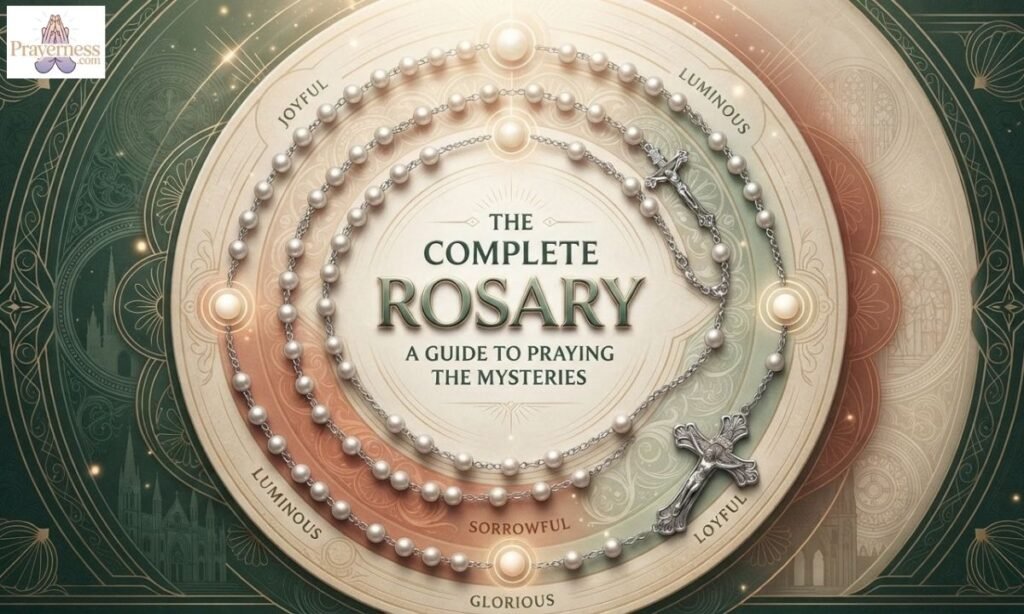
The mysteries are the soul of the rosary. Without them, it would be repetition alone.
There are four sets of mysteries, and each set has five events from the Gospels: Joyful, Sorrowful, Glorious, and Luminous. That gives twenty mysteries in all.
On a normal day, you pray only one set, which means five mysteries and five decades. Each decade gets its own mystery. Before you start the first Hail Mary of that decade, you name the mystery quietly, such as “The Annunciation,” and then spend a moment picturing the scene.
Praying “the complete rosary” in everyday language usually means one set of five decades. Praying all twenty in one sitting is possible, but it is rare and takes around two and a half hours.
Prayers of the Rosary Mysteries
Each mystery comes with a small rhythm of prayers around it.
For every decade, the pattern is the same:
- Announce the mystery and, if you like, read a short Scripture passage
- Our Father on the single bead
- Ten Hail Marys on the ten connected beads
- Glory Be after the tenth Hail Mary
- Fatima Prayer (optional but common) right after the Glory Be
Some people add a short intention at the start of each decade, such as “for my mother’s health.” This small habit keeps the prayer personal. It also keeps your mind from drifting.
What Does the Rosary Symbolize? The Deep Meaning Behind Every Bead
A rosary is more than a string of beads. Almost every part of it points to something.
The beads themselves are a tool for counting, so your mind is free to meditate. The circle reminds many people of God’s endless love and of Christ’s life, which the mysteries trace from birth to glory.
The crucifix at the start reminds you that every prayer is rooted in Christ’s sacrifice. The medal at the center often shows Mary, who stands at the heart of this devotion.
Even the shape matters. When you pray the rosary, your fingers move forward bead by bead, just as life moves forward one small step at a time. Nobody climbs the whole mountain at once.
Parts of a Rosary Explained: Beads, Crucifix, Decades, and Medals
If you are holding a rosary for the first time, here is a simple tour of what you are looking at.
- Crucifix: The cross where you begin. You make the Sign of the Cross and pray the Apostles’ Creed here.
- Tail (the short strand): The first single bead, then three beads, then a chain leading to the circle. This is where the opening prayers are prayed.
- Center medal: The piece that joins the tail to the loop. It is often an image of Mary.
- Decades: The five groups of ten small beads, called Hail Mary beads.
- Our Father beads: The single, usually larger bead between each decade.
Rosaries are made from wood, glass, stone, plastic, or even knotted cord. The material does not change the prayer. A modest rosary from a church gift shop can serve you just as well as an expensive one.
How Many Beads Are on a Rosary And What Each One Represents
The standard five-decade rosary has 59 beads, not counting the crucifix and medal.
Here is how that adds up:
- 53 Hail Mary beads: three on the tail, plus fifty in the five decades
- 6 Our Father beads: one on the tail, plus one before each decade
The three beads on the tail are traditionally offered for an increase in faith, hope, and love. Each decade of ten represents one mystery. Together, the 50 Hail Marys in the loop echo the old tradition of praying the 150 Psalms, since three rounds of five decades make 150.
Do not worry about memorizing this. Your fingers will teach you the pattern faster than your head will.
Do You Need Rosary Beads to Pray? What to Do If You Don’t Have One
No, you do not need beads to pray the rosary. Beads are a helper, not a requirement.
Many people pray it with their fingers. You can count each Hail Mary on the joints of your five fingers, using one hand for one decade and the other hand to track which decade you are on.
Other options include:
- A ten-bead finger rosary that slips on your hand
- A rosary app that counts for you
- A printed rosary card with a diagram
- A bracelet or ring made for rosary prayer
What matters is your attention and your intention. God hears the prayer, not the equipment.
All the Prayers of the Rosary Full Text for Every Beginner to Learn
You only need a handful of prayers, and you will learn them quickly through repetition. Here are the opening and repeated prayers in full. The Hail Mary, the Fatima Prayer, and the Hail Holy Queen each get their own section below.
Sign of the Cross
In the name of the Father, and of the Son, and of the Holy Spirit. Amen.
The Apostles’ Creed
I believe in God, the Father almighty, Creator of heaven and earth, and in Jesus Christ, his only Son, our Lord, who was conceived by the Holy Spirit, born of the Virgin Mary, suffered under Pontius Pilate, was crucified, died and was buried; he descended into hell; on the third day he rose again from the dead; he ascended into heaven, and is seated at the right hand of God the Father almighty; from there he will come to judge the living and the dead. I believe in the Holy Spirit, the holy catholic Church, the communion of saints, the forgiveness of sins, the resurrection of the body, and life everlasting. Amen.
Our Father
Our Father, who art in heaven, hallowed be thy name; thy kingdom come; thy will be done on earth as it is in heaven. Give us this day our daily bread, and forgive us our trespasses as we forgive those who trespass against us; and lead us not into temptation, but deliver us from evil. Amen.
Glory Be
Glory be to the Father, and to the Son, and to the Holy Spirit, as it was in the beginning, is now, and ever shall be, world without end. Amen.
Closing Prayer
O God, whose only-begotten Son, by his life, death, and resurrection, has purchased for us the rewards of eternal life, grant, we beseech thee, that while meditating on these mysteries of the most holy Rosary of the Blessed Virgin Mary, we may imitate what they contain and obtain what they promise, through the same Christ our Lord. Amen.
The Hail Mary Prayer: Words, Meaning, and How It Anchors the Rosary
The Hail Mary is the heartbeat of the rosary. You will pray it 53 times in a single five-decade rosary, so it quickly becomes familiar.
Hail Mary, full of grace, the Lord is with thee; blessed art thou amongst women, and blessed is the fruit of thy womb, Jesus. Holy Mary, Mother of God, pray for us sinners, now and at the hour of our death. Amen.
The first half comes straight from Scripture. The angel Gabriel’s greeting is found in Luke 1:28, and Elizabeth’s words to Mary are in Luke 1:42. The second half, the petition, developed in the Church over time and was widely used by the sixteenth century.
Notice that the prayer ends with Jesus’ name at the center of its first half. Even when you are speaking to Mary, you are pointing toward Christ. If your mind wanders, return to that name and you will find your footing again.
The Apostles’ Creed, Our Father, and Glory Be Opening Prayers Explained
The prayers on the crucifix and the first beads set the tone for everything that follows.
The Apostles’ Creed is a summary of Christian belief. Praying it first is like standing on solid ground before you begin a journey. You are stating who you believe in before you ask for anything.
The Our Father is the prayer Jesus himself taught his disciples, found in Matthew 6:9-13. It is the one prayer almost every Christian tradition shares, which makes it a lovely bridge for newcomers.
The Glory Be is a short burst of praise to the Trinity. After meditating on a mystery, it closes the decade with thanks, as if to say, “All of this belongs to God.”
Together, these prayers give the rosary a Christ-centered, Trinity-centered frame.
What Is the Fatima Prayer (O My Jesus) and Where Does It Fit in the Rosary?
The Fatima Prayer is a short plea added after the Glory Be at the end of each decade.
O my Jesus, forgive us our sins, save us from the fires of hell, lead all souls to heaven, especially those most in need of thy mercy.
It is linked to the apparitions of Our Lady at Fatima, Portugal, in 1917, when she is said to have asked three shepherd children to pray it. The Church has approved these apparitions as worthy of belief, but it does not require Catholics to accept them.
This is important for beginners: the Fatima Prayer is optional. Many parishes and families pray it, and many do not. If you skip it, your rosary is still complete.
Hail Holy Queen: The Closing Prayer of the Rosary With Full Text
After the fifth decade, the rosary usually ends with this ancient prayer to Mary. It is often called the Salve Regina.
Hail, holy Queen, Mother of mercy, our life, our sweetness and our hope. To thee do we cry, poor banished children of Eve; to thee do we send up our sighs, mourning and weeping in this valley of tears. Turn then, most gracious advocate, thine eyes of mercy toward us, and after this our exile, show unto us the blessed fruit of thy womb, Jesus. O clement, O loving, O sweet Virgin Mary.
V. Pray for us, O holy Mother of God.
R. That we may be made worthy of the promises of Christ.
Many find this prayer especially tender. It speaks honestly of life as a kind of exile, with its tears and tiredness, and it ends with hope. On days when fear feels louder than faith, you can pair it with prayers for protection. After the Hail Holy Queen, you pray the closing prayer and finish with the Sign of the Cross.
How to Pray the Rosary Step by Step Complete Beginner’s Walkthrough
Now let us slow down and walk through it bead by bead. Choose your set of mysteries for the day first. A schedule appears later in this article.
Opening
- Take the crucifix in your hand. Make the Sign of the Cross.
- Pray the Apostles’ Creed.
- On the first bead, pray the Our Father.
- On the next three beads, pray a Hail Mary each. You can offer these for faith, hope, and love.
- Pray the Glory Be.
The Five Decades
- Name the first mystery and pause for a few quiet breaths.
- Pray the Our Father on the single bead.
- Move through the ten beads, praying a Hail Mary on each while holding the mystery in mind.
- Pray the Glory Be, then the Fatima Prayer if you choose.
- Move to the next single bead, name the second mystery, and repeat.
Closing
- After the fifth decade, pray the Hail Holy Queen.
- Pray the closing prayer.
- Make the Sign of the Cross.
If you lose your place, simply carry on. God is not grading your accuracy.
How Long Does It Take to Pray the Rosary? (And How to Fit It Into Your Day)
A five-decade rosary usually takes 15 to 20 minutes when prayed at a calm, steady pace. Beginners may need 25 minutes while they learn the words.
That is shorter than a TV episode, but it can still feel hard to find the time. A few simple ideas:
- Pray it first thing in the morning, before the house wakes up
- Use a lunch break once or twice a week
- Pray while the kettle boils or the kids nap
- Keep your rosary by your bedside for evenings
Choose a time that already exists in your day and attach the rosary to it. A small, steady habit will always beat a grand plan that collapses after three days.
How to Pray One Decade of the Rosary When You’re Short on Time
Some days are simply full. On those days, one decade is still a real prayer.
A single decade takes about three to four minutes. Here is how:
- Make the Sign of the Cross.
- Name one mystery and picture it.
- Pray one Our Father.
- Pray ten Hail Marys.
- Pray one Glory Be.
- Finish with the Sign of the Cross.
Many Catholics call this “a decade a day.” You could pray one decade in the morning, another at lunch, and so on, finishing the rosary by evening. It turns a long prayer into small, doable pieces.
Common Mistakes Beginners Make When Praying the Rosary and How to Avoid Them
Almost every beginner makes the same few missteps. They are easy to fix.
- Rushing. Racing through words defeats the purpose. Slow down and let each Hail Mary breathe.
- Worrying about perfection. Losing count or forgetting a line is normal. Just continue.
- Skipping the mysteries. Reciting without meditating turns it into a chant. Even a simple picture in your mind helps.
- Expecting a big feeling. Some days the rosary feels dry. Pray anyway.
- Quitting after a rough start. The first week is the hardest. It gets lighter.
- Praying the wrong mystery. If that happens, relax. No one is counting except you.
Gentleness with yourself is part of the prayer.
The Four Sets of Rosary Mysteries Explained: Joyful, Sorrowful, Glorious, and Luminous
Each set of mysteries covers a different chapter of the Gospel story.
- Joyful: Jesus’ birth and childhood
- Luminous: Jesus’ public ministry
- Sorrowful: Jesus’ suffering and death
- Glorious: Jesus’ resurrection and its fruits
Together, they trace the whole arc of salvation. If you pray through all four sets over a week, you walk from the stable in Bethlehem to the crowning of Mary in heaven. Few prayers cover so much in so simple a form.
The Joyful Mysteries of the Rosary What They Are and When to Pray Them
The Joyful Mysteries focus on wonder, humility, and the arrival of Christ.
- The Annunciation: Gabriel invites Mary to be the mother of the Savior (Luke 1:26-38).
- The Visitation: Mary visits her cousin Elizabeth (Luke 1:39-56).
- The Nativity: Jesus is born in Bethlehem (Luke 2:1-20).
- The Presentation: Mary and Joseph present Jesus in the Temple (Luke 2:22-38).
- The Finding in the Temple: The boy Jesus is found among the teachers (Luke 2:41-52).
Traditionally, these are prayed on Mondays and Saturdays, and on Sundays during Advent. They are lovely when you are starting something new, expecting a child, or simply need a lighter heart.
The Sorrowful Mysteries of the Rosary Meditating on Christ’s Passion
The Sorrowful Mysteries are hard to pray, yet they are often the ones people love most. They remind us that Jesus entered human pain fully.
- The Agony in the Garden: Jesus prays in Gethsemane (Luke 22:39-46).
- The Scourging at the Pillar: Jesus is whipped (John 19:1).
- The Crowning with Thorns: Soldiers mock him as king (Matthew 27:27-31).
- The Carrying of the Cross: Jesus walks toward Calvary (John 19:17).
- The Crucifixion: Jesus dies on the cross (Luke 23:33-46).
These are traditionally prayed on Tuesdays and Fridays, and on Sundays during Lent. If you are grieving or carrying a heavy burden, this set can feel like sitting beside a friend who understands. If someone you love is unwell, you can also offer a decade for them alongside prayers for healing the sick.
The Glorious Mysteries of the Rosary From the Resurrection to the Coronation of Mary
After the cross comes the dawn. The Glorious Mysteries celebrate hope and the victory of God.
- The Resurrection: Jesus rises from the dead (Matthew 28:1-10).
- The Ascension: Jesus returns to the Father (Acts 1:6-11).
- The Descent of the Holy Spirit: The Spirit comes at Pentecost (Acts 2:1-4).
- The Assumption: Mary is taken up, body and soul, into heaven.
- The Coronation: Mary is honored as Queen of Heaven.
These are traditionally prayed on Wednesdays and Sundays. The last two mysteries come from Church tradition rather than a direct Gospel account, though Catholics see them rooted in the biblical hope of resurrection and in Revelation 12.
The Luminous Mysteries of the Rosary The Five Mysteries Added by Pope John Paul II
The Luminous Mysteries, also called the Mysteries of Light, are the newest addition. Pope John Paul II introduced them in 2002 in his apostolic letter Rosarium Virginis Mariae.
He noticed that the rosary jumped from Jesus’ childhood straight to his suffering. The new mysteries fill that gap with his public life.
- The Baptism of Jesus: The Spirit descends at the Jordan (Matthew 3:13-17).
- The Wedding at Cana: Jesus performs his first sign (John 2:1-12).
- The Proclamation of the Kingdom: Jesus calls everyone to repent and believe (Mark 1:14-15).
- The Transfiguration: Jesus shines with glory on the mountain (Luke 9:28-36).
- The Institution of the Eucharist: Jesus gives himself at the Last Supper (Luke 22:14-20).
They are praying on Thursdays. Praying them is optional, but many Catholics treasure them.
Which Rosary Mystery to Pray on Which Day of the Week (Full Weekly Schedule)
Here is the traditional schedule most Catholics follow:
| Day | Mysteries |
| Monday | Joyful |
| Tuesday | Sorrowful |
| Wednesday | Glorious |
| Thursday | Luminous |
| Friday | Sorrowful |
| Saturday | Joyful |
| Sunday | Glorious (Joyful in Advent, Sorrowful in Lent) |
This is a custom, not a rule. If you feel drawn to a different set on a given day, God will not be upset. The schedule simply gives your week a gentle shape.
Is the Rosary in the Bible? The Scriptural Foundation of Every Rosary Prayer
The word “rosary” does not appear in the Bible, and the prayer in its present form developed over centuries. Still, nearly every part of it comes from Scripture.
- The Our Father comes from Matthew 6:9-13 and Luke 11:2-4.
- The first half of the Hail Mary is from Luke 1:28 and Luke 1:42.
- The Apostles’ Creed summarizes the faith of the New Testament.
- The Glory Be echoes Trinitarian praise found throughout the Bible.
- Most mysteries are drawn directly from the Gospels and Acts.
Catholics would say the rosary is biblical in content, even if it is traditional in form. That is why many people pray it with an open Bible nearby.
The Rosary as Meditation on the Life of Christ Scripture Behind Each Mystery
Pope John Paul II described the rosary as a “compendium of the Gospel.” It is a way of reading the Gospel with your heart.
A simple method is this: before each decade, read the matching Bible verses listed above. Then ask yourself a short question.
- Annunciation: Where is God asking for my “yes”?
- Agony in the Garden: What am I afraid to surrender?
- Resurrection: Where do I need new hope?
- Wedding at Cana: What do I need Jesus to change in my life?
You do not have to answer perfectly. Just let the scene sit with you while your fingers move along the beads.
The History of the Rosary: From Ancient Prayer Beads to the Modern Devotion
The rosary grew slowly, like a tree, rather than appearing all at once.
Early Christians, especially monks, prayed the 150 Psalms daily. Many ordinary people could not read, so they prayed 150 Our Fathers instead, often counting them on knotted cords or strings of pebbles. Later, the Hail Mary replaced the Our Father in this practice, and the devotion became known as “Our Lady’s Psalter.”
By the 1400s, meditating on events from Christ’s life while praying had become common. In 1569, Pope Pius V formally recognized the rosary’s structure. A few years later, the naval victory at Lepanto in 1571 was credited by many to rosary prayer, which added to the devotion’s fame.
Pope John Paul II added the Luminous Mysteries in 2002. Today the rosary is prayed around the world, in hundreds of languages.
Who Invented the Rosary? St. Dominic, Dominic of Prussia, and the True Origin Story
You may have heard that Mary gave the rosary to Saint Dominic in the early 1200s. It is a beloved tradition, but historians have found little evidence for it from Dominic’s own lifetime.
Most scholars now see the rosary as a gradual development with several contributors. Saint Dominic and the Dominican order certainly helped spread the devotion, especially through later preachers.
A Carthusian monk named Dominic of Prussia (early 1400s) is often credited with linking short meditations to the Hail Marys. Blessed Alan de la Roche further popularized the practice in the late 1400s.
So who invented it? No single person did. It was shaped by monks, preachers, and ordinary believers over hundreds of years. That is part of its beauty. It truly belongs to the people.
What Does “Rosary” Mean? The Etymology, Symbolism, and “Crown of Roses” Tradition
The word “rosary” comes from the Latin rosarium, which means “rose garden” or “garland of roses.”
The rose has long been a symbol of Mary. In medieval imagery, roses stood for love, purity, and beauty. A tradition grew that each Hail Mary offered to Mary was like presenting her with a rose, and a complete rosary formed a lovely crown.
In some languages, the rosary is also called a “chaplet,” from a French word for a small wreath. When you pray it, you are weaving a garland of prayer, one flower at a time. That image alone can make a distracted prayer feel tender again.
Can Non-Catholics Pray the Rosary? What You Need to Know Before You Begin
Yes, anyone can pray the rosary. Nobody checks your baptismal certificate at the door.
If you are not Catholic, it helps to know a few things first:
- The rosary includes prayers to Mary, asking her to intercede for you
- Catholics do not worship Mary. They honor her and ask for her prayers, much as you might ask a friend to pray for you
- You can pray the Creed, Our Father, and the meditations on Christ’s life without difficulty
- You may choose how comfortable you are with the Marian parts
Read the prayers slowly first. If you have questions, a priest or a trusted Catholic friend is usually glad to talk.
Is the Rosary Only for Catholics? How Christians of Other Denominations View It
The rosary is rooted in Catholic tradition, but its appeal has spread beyond it.
Orthodox Christians use a similar prayer rope with the Jesus Prayer. Anglicans and some Lutherans pray with Anglican prayer beads or a version of the rosary. Many other Protestants keep a respectful distance, mostly because of the prayers to Mary and the concern about “vain repetitions” in Matthew 6:7.
Catholics respond that Jesus warned against empty babbling, not heartfelt repetition, and that Jesus himself prayed the same words in Gethsemane. Reasonable believers still disagree.
If this tradition is new to you, you can approach it as a student, not a convert. Curiosity is a fine place to begin.
How to Stay Focused While Praying the Rosary Practical Tips for Beginners
Wandering thoughts happen to everyone, even saints. They do not ruin the prayer.
Try these practical tips:
- Choose a quiet spot. Silence your phone and dim the lights if it helps.
- Picture the scene. Imagine the sights, sounds, and faces of the mystery.
- Pray an intention. Give each decade to a person or need.
- Pray aloud. Hearing your voice keeps your mind anchored.
- Hold the beads firmly. The touch helps your body participate.
- Begin gently again. When you drift, simply return without scolding yourself.
Distractions are not failures. Returning to prayer again and again is itself an act of love, and on tired days daily morning prayers for strength can help you settle before you begin.
How to Make the Rosary a Daily Habit: Building a Consistent Prayer Routine
A habit grows when it is small, specific, and attached to something you already do.
Start with one decade a day for a week. Then add a second decade, and so on. Keep your rosary where you will see it, like your car, your nightstand, or your coffee mug area.
You can also:
- Choose the same time and place every day
- Track your streak on a calendar
- Pray with a friend by text or phone
- Forgive yourself quickly when you miss a day
Missing a day does not erase your progress. Start again the next morning, and keep starting again. Over months, that quiet faithfulness can change you more than you expect.
Praying the Rosary While Walking, Driving, or Commuting Does It Count?
Yes, it counts, with one sensible caution.
Praying while walking is a long and honorable tradition. Moving your body can even help some people stay awake and focused. Praying on a bus or train works well too. Use your fingers or a finger rosary to keep count.
Driving requires more care. Your first duty is to keep yourself and others safe. If you pray while driving, use an audio rosary and keep your hands on the wheel. Do not close your eyes, and never let it distract you from the road.
God meets you in your ordinary routines. Still, many people find that on days when they can, a quiet, undistracted rosary feels deeper.
How to Pray the Rosary With Your Family or in a Group
Praying together is one of the most beautiful ways to experience the rosary. The old saying goes, “The family that prays together stays together.”
In a group, it is usually prayed in a call-and-response style. One person leads by saying the first half of each prayer, and everyone else answers with the second half. For example, the leader says “Hail Mary, full of grace…” and the group responds “Holy Mary, Mother of God…”
For families with children:
- Keep it short, perhaps one decade
- Let a different child announce each mystery
- Let kids hold sacred images or small figures
- End with a hug or a favorite song
Do not worry if it feels noisy or imperfect at first. Little ones learn by watching you.
Best Apps and Audio Guides to Help You Pray the Rosary as a Beginner
Technology can be a surprisingly gentle teacher. Many beginners find that an app removes the fear of getting it wrong.
Look for tools that offer:
- Audio recordings that pray along with you
- On-screen text of each prayer
- Daily mystery reminders
- Options for different lengths and languages
- Scripture readings for each mystery
Popular choices include Hallow, Rosary Army, and Laudate, along with many free audio rosaries on YouTube and podcast platforms. Features and pricing change often, so check each app’s current details before you commit.
Choose a voice and pace that feel calm to you. That small detail makes a big difference.
Guided Rosary vs. Solo Rosary: Which Is Better for Beginners?
Both have their place, and many people use both.
A guided rosary is helpful when you are learning. A voice leads you through each prayer, so you never wonder what comes next. It is also wonderful on days when you feel tired or distracted.
A solo rosary lets you set your own pace, linger on a mystery, or pray in silence. It tends to feel more personal and flexible.
For most beginners, here is a simple path: start with a guided rosary for the first few weeks. Once the prayers feel familiar, try a solo rosary a few times a week. Over time, you will find your own balance. There is no wrong answer.
Frequently Asked Questions
What is the rosary in simple terms?
The rosary is a Catholic prayer that combines repeated prayers, mainly the Hail Mary, with meditation on key events in the life of Jesus and Mary.
How many Hail Marys are in a rosary?
A standard five-decade rosary has 53 Hail Marys: three in the opening, plus ten in each of the five decades.
Which mysteries should I pray today?
Traditionally, Joyful on Monday and Saturday, Sorrowful on Tuesday and Friday, Glorious on Wednesday and Sunday, and Luminous on Thursday.
Can I pray the rosary without beads?
Yes. You can count the Hail Marys on your fingers or use an app. Beads are only an aid.
Is it okay if I lose my place or get distracted?
Yes. Simply pick up where you think you left off. Distraction is normal, and returning to the prayer matters more than perfection.
Final Thoughts
The rosary may look complicated, but at its core it is a quiet conversation with God, held through the story of Jesus and the company of Mary. You do not need to master every detail on day one. Begin with one decade and let the rhythm do its gentle work.
If you ever feel unsure, remember that every faithful pray-er started exactly where you are now, holding unfamiliar beads and wondering if they were doing it right. Keep going, one Hail Mary at a time. In the steady, simple repetition, many people find peace they could not have planned for.